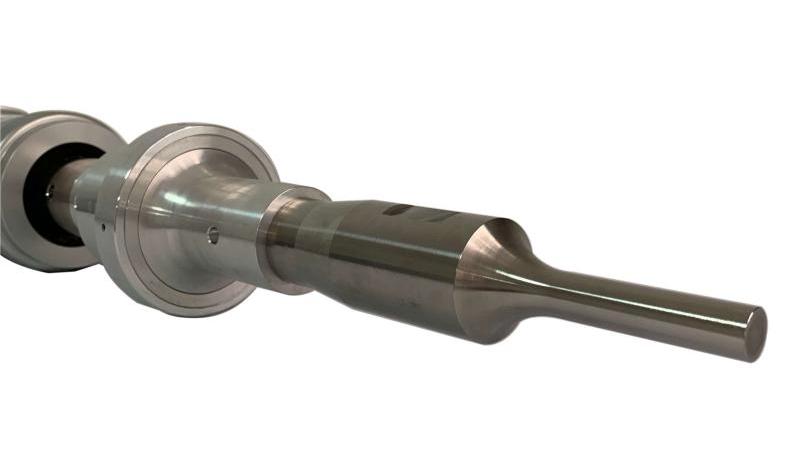

Manufacturer of Chemical Materials Dispersing Equipment
Product Main Parameters
| Model | Frequency | Power | Voltage | Pressure | Intensity of Sound | Material of Probe | Generator |
|---|---|---|---|---|---|---|---|
| H-UH20-1000S | 20KHz | 1000 W | 220V | Normal | >10 W/cm² | Titanium Alloy | Digital type |
| H-UH20-1000 | 20KHz | 1000 W | 220V | Normal | >10 W/cm² | Titanium Alloy | Digital type |
| H-UH20-2000 | 20KHz | 2000W | 220V | 35 MPa | >40 W/cm² | Titanium Alloy | Digital type |
| H-UH20-3000 | 20KHz | 3000W | 220V | 35 MPa | >60 W/cm² | Titanium Alloy | Digital type |
Common Product Specifications
| Feature | Detail |
|---|---|
| Frequency | 20KHz |
| Power Range | 1000W to 3000W |
| Voltage | 220V |
| Material of Probe | Titanium Alloy |
| Pressure Capability | Normal to 35 MPa |
Product Manufacturing Process
The manufacturing of ultrasonic homogenizers involves precision engineering and quality control processes. The probe, typically made of titanium alloy, is designed for durability and performance. Digital generators are calibrated for accurate power delivery, ensuring optimal cavitation effects. Quality control measures are aligned with industry standards to maintain consistency and reliability. The use of advanced machining and welding techniques ensures robust assembly. Overall, the manufacturing process focuses on precision engineering to achieve high efficiency in chemical materials dispersing, as documented in recent industrial manufacturing studies.
Product Application Scenarios
Ultrasonic homogenizers serve critical roles in various industries such as pharmaceuticals, food processing, and nanotechnology. Their ability to enhance chemical materials dispersing makes them invaluable in improving product consistency and quality. Studies show their effectiveness in accelerating reactions, improving dispersion of nanoparticles, and homogenizing mixtures. The technology's versatility caters to diverse applications, including emulsification and cell lysing, proving indispensable in research and industrial settings. These scenarios highlight the significance of ultrasonic processing in achieving superior dispersion outcomes, as supported by numerous academic analyses.
Product After-Sales Service
Our after-sales service includes technical support, maintenance services, and spare parts provision. Customers can access our dedicated support team for troubleshooting and operational advice. We ensure a swift response to inquiries and technical issues, enhancing our reputation as a dependable manufacturer in chemical materials dispersing solutions.
Product Transportation
Our products are packed in standard export packaging to prevent damage during transit. We offer efficient logistics solutions to ensure prompt delivery, supported by our extensive supply chain network. This commitment to effective transportation aligns with our goal of maintaining high customer satisfaction levels.
Product Advantages
1. Increased extraction rate and reduced extraction time. 2. Energy-efficient operation. 3. Suitable for heat-sensitive substances, requiring no heating. 4. Lower operational costs compared to traditional methods. 5. Improved stability in liquid-liquid mixtures. 6. Effective nanoparticle dispersion in solid-liquid mixtures. 7. Enhanced precision in particle dispersing. 8. Robust construction with titanium alloy probes. 9. Advanced digital generator for precise power delivery. 10. Extensive application flexibility across industries.
Product FAQ
- Q1: What makes ultrasonic homogenizers effective in chemical materials dispersing?
A1: They utilize acoustic cavitation to break down particles efficiently, enhancing dispersion quality.
- Q2: How does a manufacturer ensure the quality of these machines?
A2: Stringent quality control processes, including precision engineering and calibration, maintain high standards.
- Q3: What industries benefit from using ultrasonic homogenizers?
A3: Pharmaceuticals, food processing, and nanotechnology benefit from enhanced chemical materials dispersing.
- Q4: Can ultrasonic homogenizers be used for nanoparticle dispersion?
A4: Yes, they effectively disperse nanoparticles, preventing agglomeration and ensuring uniform distribution.
- Q5: What are the maintenance requirements for these machines?
A5: Regular inspection and cleaning of probes, along with scheduled maintenance, prolong operational life.
- Q6: Is operator training necessary for using these machines?
A6: Basic training is recommended to ensure optimal operation and understanding of safety measures.
- Q7: How do ultrasonic homogenizers improve chemical reaction speeds?
A7: They enhance mixing efficiency and create conditions favorable for faster reactions through cavitation.
- Q8: Are these machines suitable for large-scale production?
A8: Yes, they are designed for scalability, making them suitable for both lab and industrial applications.
- Q9: How are these machines typically transported?
A9: They are safely packaged in standard export packaging to avoid transit damage.
- Q10: What support does the manufacturer provide post-purchase?
A10: Comprehensive technical support and timely maintenance services are available to customers.
Product Hot Topics
- Ultrasonic Technology in Chemical Materials Dispersing
Ultrasonic homogenizers have revolutionized chemical materials dispersing, with many manufacturers integrating this technology to enhance product consistency. The method's efficiency in breaking down particles aligns with industry demands for improved quality and performance. As research progresses, new advancements in ultrasonic technology continue to shape the future of manufacturing, offering innovative solutions for complex dispersing challenges.
- Eco-Friendly Manufacturing Practices
The adoption of ultrasonic homogenizers reflects a broader trend towards eco-friendly manufacturing practices. By reducing energy consumption and eliminating the need for heating, manufacturers can lower their carbon footprint. This aligns with global sustainability goals, as industries strive to balance efficiency with environmental responsibility. As such, ultrasonic technology is gaining recognition as a green alternative in materials processing.
- Applications in Nanotechnology
In nanotechnology, precise particle dispersing is crucial. Ultrasonic homogenizers have become indispensable tools for manufacturers aiming to achieve uniform nanoparticle distribution. Their ability to tackle the challenges of agglomeration and stability makes them a preferred choice in this field. As nanotechnology continues to advance, the demand for efficient dispersing solutions is set to rise, positioning ultrasonic homogenizers at the forefront of innovation.
- Optimizing Production Efficiency
Optimizing production efficiency is a key goal for manufacturers. Ultrasonic homogenizers contribute to this by reducing extraction times and enhancing chemical reactions. These benefits translate to cost savings and higher throughput, delivering a competitive edge in the marketplace. As industries pursue operational excellence, the role of advanced dispersing equipment becomes increasingly significant.
- The Role of Dispersing Agents
Dispersing agents play a vital role in achieving stable chemical materials dispersing. Their interaction with ultrasonic homogenizers enhances the effectiveness of dispersion processes. By understanding the mechanisms of agent functionality, manufacturers can fine-tune their operations to maximize product quality. This synergy between technology and chemistry is pivotal in advancing material processing capabilities.
- Challenges in Industrial Scale-Up
Scale-up presents challenges for manufacturers transitioning from laboratory to industrial production. Ultrasonic homogenizers offer scalable solutions for chemical materials dispersing, addressing issues such as consistency and efficiency. By providing robust performance at larger scales, these machines support seamless transition, ensuring that quality is maintained throughout the production process.
- Sustainability and Ultrasonic Processing
Sustainability is a growing concern for manufacturers. Ultrasonic processing stands out for its eco-efficiency, reducing energy usage and minimizing waste. By adopting this technology, companies can achieve their sustainability targets while maintaining high production standards. This balance of eco-friendly practices and operational success is critical as industries navigate environmental challenges.
- Advancements in Probe Material
The development of advanced probe materials, such as titanium alloys, enhances the durability and performance of ultrasonic homogenizers. Manufacturers prioritize material innovation to withstand the rigors of chemical materials dispersing. This focus on materials science ensures that equipment remains reliable and effective, meeting the demands of modern processing environments.
- Impact on Product Quality
The impact of ultrasonic homogenizers on product quality is significant. By ensuring thorough dispersion, they help manufacturers produce materials with consistent properties. This consistency is crucial in industries where quality is paramount, such as pharmaceuticals and food processing. As quality standards become more stringent, the role of precision equipment in meeting these demands is highlighted.
- Future Trends in Dispersing Technology
The future of dispersing technology is shaped by continuous innovation. Ultrasonic homogenizers are at the forefront of this evolution, with manufacturers exploring new capabilities and applications. Emerging trends point towards greater automation and integration with digital systems, promising enhanced efficiency and control. As technology advances, the potential for groundbreaking developments in dispersing techniques is boundless.
Image Description